
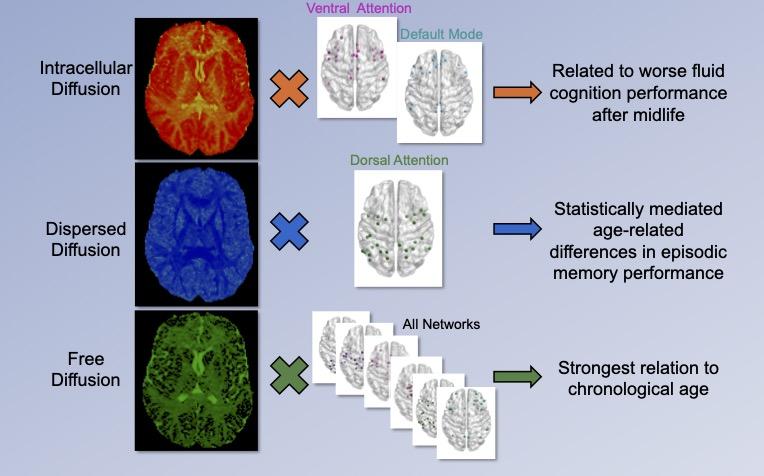
Cognitive decline, in healthy older adults without cognitive impairment or dementia, has been associated with numerous microstructural alterations in brain tissue using magnetic resonance imaging (MRI). Prior studies have primarily linked age-related cognitive decline to alterations in white matter tissue, but methodological advances in diffusion-weighted imaging (dMRI) data acquisition and modeling now allow for these analyses to be extended to gray matter tissue. Here, using a sample of 152 healthy adults (18–88 years of age), we used a multicompartment dMRI model to assess (1) age-related differences in gray matter microstructure of functionally defined networks and (2) whether microstructural alterations accounted for age-related differences in episodic memory and speed-dependent fluid cognition. We observed significant age-related alterations in gray matter tissue in the form of nonlinear, age-related increases and decreases in intracellular and dispersed diffusion, respectively, and linear increases in free diffusion. Free diffusion exhibited the most pronounced age-related effects, especially for frontoparietal relative to occipital regions. Dispersed diffusion in the dorsal attention network statistically mediated age-related differences in episodic memory performance. Moreover, higher intracellular diffusion in the default mode and ventral attention networks was related to worse fluid cognition performance, but only for adults > 51 years of age. These results suggest that healthy aging is accompanied by distinct profiles of gray matter microstructural alterations that negatively affect memory and speed-dependent cognition, the latter of which is more pronounced after midlife.
Merenstein, J. L., I. J.Bennett, and D. J.Madden. 2026. “Contributions of Gray Matter Microstructure to Differences in Fluid Cognition and Episodic Memory Across the Healthy Adult Lifespan.” Human Brain Mapping47, no. 5: e70511. https://doi.org/10.1002/hbm.70511.